What the Trend Actually Is
The 2026 Halloween costume rankings put a haunted unicorn mascot near the top of the overall list. The appeal is easy to explain. A unicorn is already a costume shorthand; making it horror-adjacent adds a twist without requiring a complicated prop. The horn, the mane and the fog do most of the work. That is also why the idea works in AI: the silhouette survives compression, small screens and a single light source.
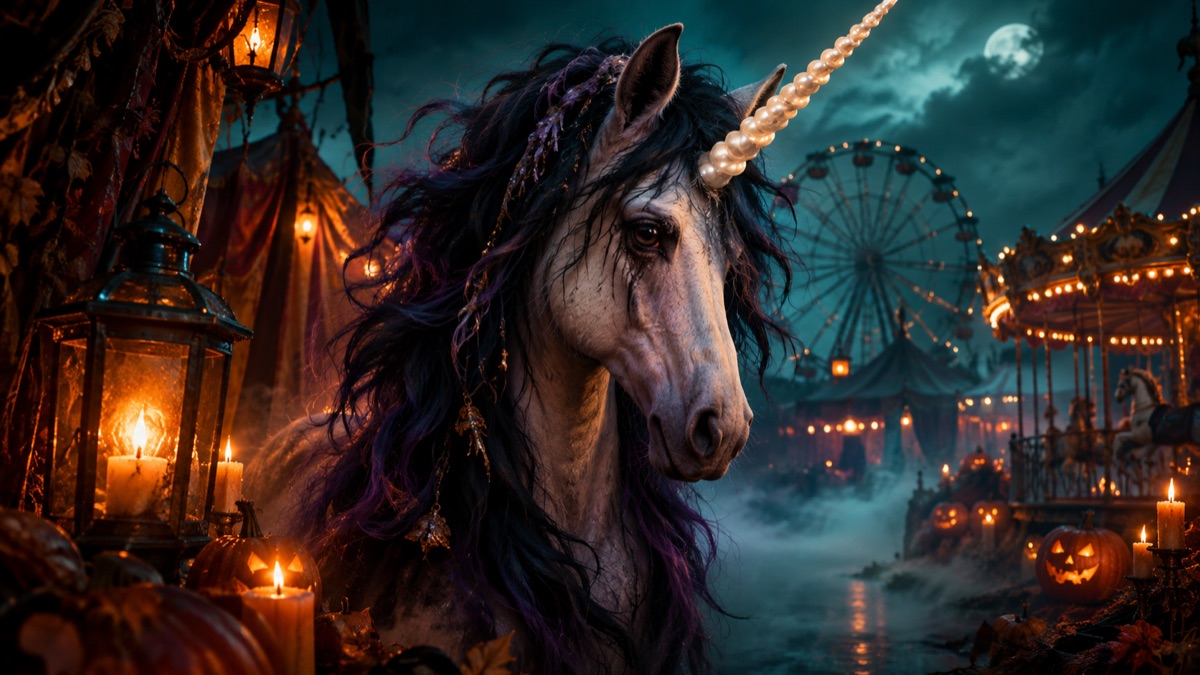
The trend is tied to a horror film mascot, but the costume does not require a specific face. That distinction matters for anyone generating an image. You can evoke the trend with a pearl horn, a smoky mane and a carnival scene without reproducing a character's exact design or claiming an official connection.
The Search Signal
Public trend coverage in October 2026 placed the exact costume phrase among the fastest-rising Halloween searches. Third-party keyword tools showed a low difficulty score, which is common for a seasonal phrase that has demand before established pages appear. That does not mean the keyword is easy to monetize or that a new page will rank immediately. It means the competition is still thin.
The useful lesson is not 'chase this one keyword'. It is that a specific visual trend with a clear prop can support a page, a tool and a set of social assets at the same time. A generic 'Halloween costume' page cannot compete with established retailers. A page about one look can be genuinely useful.
- Demand rises sharply in the two weeks before Halloween.
- Third-party volume estimates lag the peak, so the number often looks smaller than the real spike.
- Low difficulty is a signal to test, not a guarantee of rankings.
- The page should still work after the season by updating the look and the date.
Building the Look Without Copying
Start with three elements: a pearl or bone-coloured horn, a layered dark mane and a wearable costume silhouette. Add one scene cue, such as carnival fog, a striped tent or a row of warm lanterns. Keep the face visible. A full mascot head removes the identity you uploaded and pushes the result toward a generic costume render.
The prompt should explicitly say 'original' and avoid naming a studio, actor or franchise. It should also forbid text, logos and watermarks. If you plan to sell a costume or use the image in advertising, check the rights holder's terms and consult a professional. A trend guide is not a licence.
| Element | Original interpretation | What to avoid |
|---|---|---|
| Horn | Pearl or bone-coloured theatrical prop | A exact replica of a film prop |
| Mane | Layered dark fibre with silver strands | A specific character's exact hairstyle |
| Face | The uploader's face, visible | A mascot head or actor likeness |
| Scene | Foggy carnival or moonlit garden | A copied film still |
| Text | None | Logos, titles or franchise names |
Make It a Group Without Breaking It
The unicorn works best as a solo portrait. If you want a couple or a group, generate each person separately and combine the images in a photo editor. A single prompt with three people has to preserve three identities and three costumes, and the failure rate climbs quickly. If you must generate a couple in one frame, use a two-person prompt with explicit order and a face check.
For a party invitation, a solo portrait plus a second portrait in the same palette reads as a coordinated set even if the two images were generated separately. Consistency comes from the palette and the scene, not from cramming everyone into one prompt.
What to Post and What to Skip
Post the image with a clear label that it is AI-generated. Do not imply that it is an official costume, a film still or a product photo. If you are selling a physical costume, use a real photo of the product and keep the AI image as a styling reference. If you are making a TikTok, pair the image with a short clip and a simple hook: 'I turned my selfie into the haunted unicorn trend'.
Skip the temptation to add fake search data or a fake countdown. The trend is strong enough without invented urgency. The page and the post should be useful after the trend cools, which is the difference between a seasonal asset and a disposable one. For the photo itself, a plain background and a single warm light are enough. Avoid a ring light directly in front of the face; it flattens the shadows that make a mascot portrait feel theatrical. A window on one side and a dark wall on the other gives the model a clear light direction. If you are shooting at night, a single lamp behind the camera and a second lamp behind the subject creates the rim light that separates the mane from the background. If you want a repeatable shoot, prepare three files: the original selfie, the generated portrait and a short video clip. Post the selfie first as a story, then the portrait as a carousel, then the clip as a reel. The sequence gives people a reason to follow the account rather than just like one image. Keep the caption specific: the preset name, the model, the fact that it is AI and the one thing you changed. Specific captions get saved; vague ones get scrolled. Finally, do not overstay the trend. A haunted unicorn page published in the last week of October has a short window. Publish early, update the date and the preset after Halloween, and reuse the same URL for a winter masquerade look. The technical workflow is the durable asset; the character reference is the seasonal wrapper. That is also why the page should show the prompt and the model, not just the result. A reader who can see how the look was built can adapt it to a different theme next year instead of waiting for another trend.
Frequently asked questions
Is Buddy the Unicorn a real costume trend?
Yes. Public Halloween costume rankings in October 2026 placed a haunted unicorn mascot among the top costume searches. The exact character is tied to a horror film; this guide covers an original interpretation.
Can I generate the exact film character?
This guide does not provide prompts for copying a specific character or actor likeness. Use an original unicorn mascot interpretation and respect the rights holder's terms.
Why does the keyword have low difficulty?
Seasonal trend phrases often have low measured difficulty because demand rises before many established pages target them. Low difficulty is a test signal, not a guarantee.